













Union Home Minister says all 21 NDA-ruled states will bring in the Uniform Civil Code before the 2029 Lok Sabha elections; tribal communities to remain exempt
GUWAHATI, Sept 14: Union Home Minister Amit Shah’s announcement that the Uniform Civil Code (UCC) will be implemented in all 21 states governed by the BJP-led National Democratic Alliance before the 2029 Lok Sabha elections has put a major national policy question back in the spotlight — and few regions have more at stake in the debate than Northeast India.
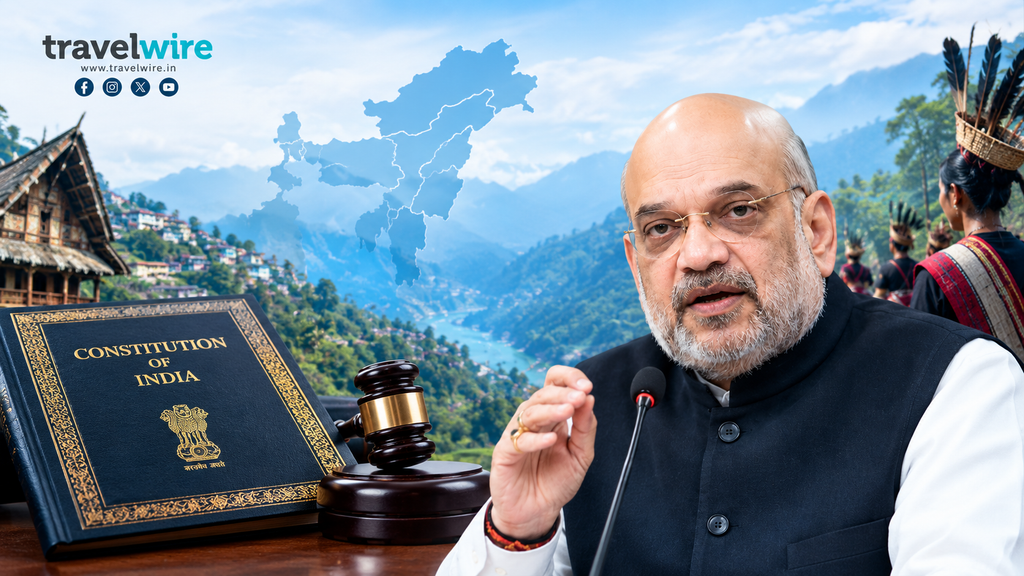
Speaking to the media in Mumbai on Sunday, Shah said the government was committed to extending the UCC across all NDA-ruled states. The proposed legal framework concerns personal-law matters including marriage, divorce and inheritance, with the stated objective of bringing greater uniformity in civil laws.
But for the Northeast, the question is not simply about uniformity of law.
It is also about custom, tribal identity and constitutional protections.
Why the Northeast is different
Several communities across Northeast India continue to follow customary practices governing aspects of family, inheritance, marriage and community life.
The Constitution itself recognises the region’s distinctive social and political arrangements through provisions such as the Sixth Schedule, which provides autonomous governance arrangements for tribal areas in Assam, Meghalaya, Tripura and Mizoram.
The region also has state-specific constitutional protections and long-standing customary institutions.
That history has made previous discussions around UCC particularly sensitive in states such as Nagaland, Meghalaya and Mizoram, where political and civil-society voices have raised concerns about the possible impact on customary laws and tribal practices.
Shah’s tribal exemption is significant
Against that backdrop, one part of Shah’s latest announcement is particularly important for Northeast India.
Shah said tribal communities would be exempted from the UCC in order to preserve their ethnic customs, traditions and identity.
That assurance could become a central part of the UCC conversation in the Northeast.
However, the practical implications will depend on how individual state laws, exemptions and constitutional protections interact with the eventual legal framework.
For communities with established customary systems, the details of implementation may matter as much as the headline announcement itself.
Assam has already entered the UCC debate
The issue is not entirely new to the Northeast.
Assam has already moved significantly into the UCC discussion. The Assam Legislative Assembly’s official digital library lists the Uniform Civil Code, Assam, 2026, with the legislation providing that it will come into force on a date notified by the state government.
The development gives Assam a particularly important position in the Northeast’s UCC story.
It also means that the region is not approaching the issue from a blank slate: there is already legislative experience that could influence how the broader UCC rollout is understood.
What about the Sixth Schedule?
This is likely to be one of the biggest questions for Northeast India.
The Sixth Schedule was designed to provide a degree of autonomy and self-governance to tribal areas in the region. Autonomous district councils operate in parts of Assam, Meghalaya, Mizoram and Tripura, with powers relating to local administration and customary matters.
Any wider UCC implementation will therefore be closely watched in areas where customary law and constitutional autonomy intersect.
The key question will be:
How will a common civil framework coexist with the region’s constitutionally recognised customary and autonomous institutions?
Shah’s assurance regarding tribal exemptions addresses one part of that concern, but the exact legal boundaries will become clearer only as legislation and rules are developed.
Why this matters beyond politics
The UCC debate is often presented as a question of political ideology.
In the Northeast, however, it also touches on identity, customary law, women’s rights, family law and constitutional safeguards.
Supporters of the UCC argue that common civil laws can promote equality and reduce discrimination between citizens belonging to different communities. Shah has presented the measure as part of the government’s broader reform agenda and linked it to equal rights.
Critics and regional groups, meanwhile, have historically raised concerns about protecting indigenous customs and ensuring that national legal reforms do not weaken community-based institutions.
For Northeast India, both sides of that discussion are important.
The road to 2029
Shah’s announcement gives NDA-ruled states a clear political deadline: before the 2029 Lok Sabha elections.
What happens next will be closely watched.
Individual states will have to consider the legislative, administrative and constitutional dimensions of implementation, while communities and political parties in the Northeast are likely to seek greater clarity over exemptions and the protection of customary practices.
For the region, the UCC debate is therefore unlikely to be simply about whether there will be a common civil code.
It will increasingly be about how a common framework can accommodate Northeast India’s extraordinary diversity of communities, customs and constitutional arrangements.